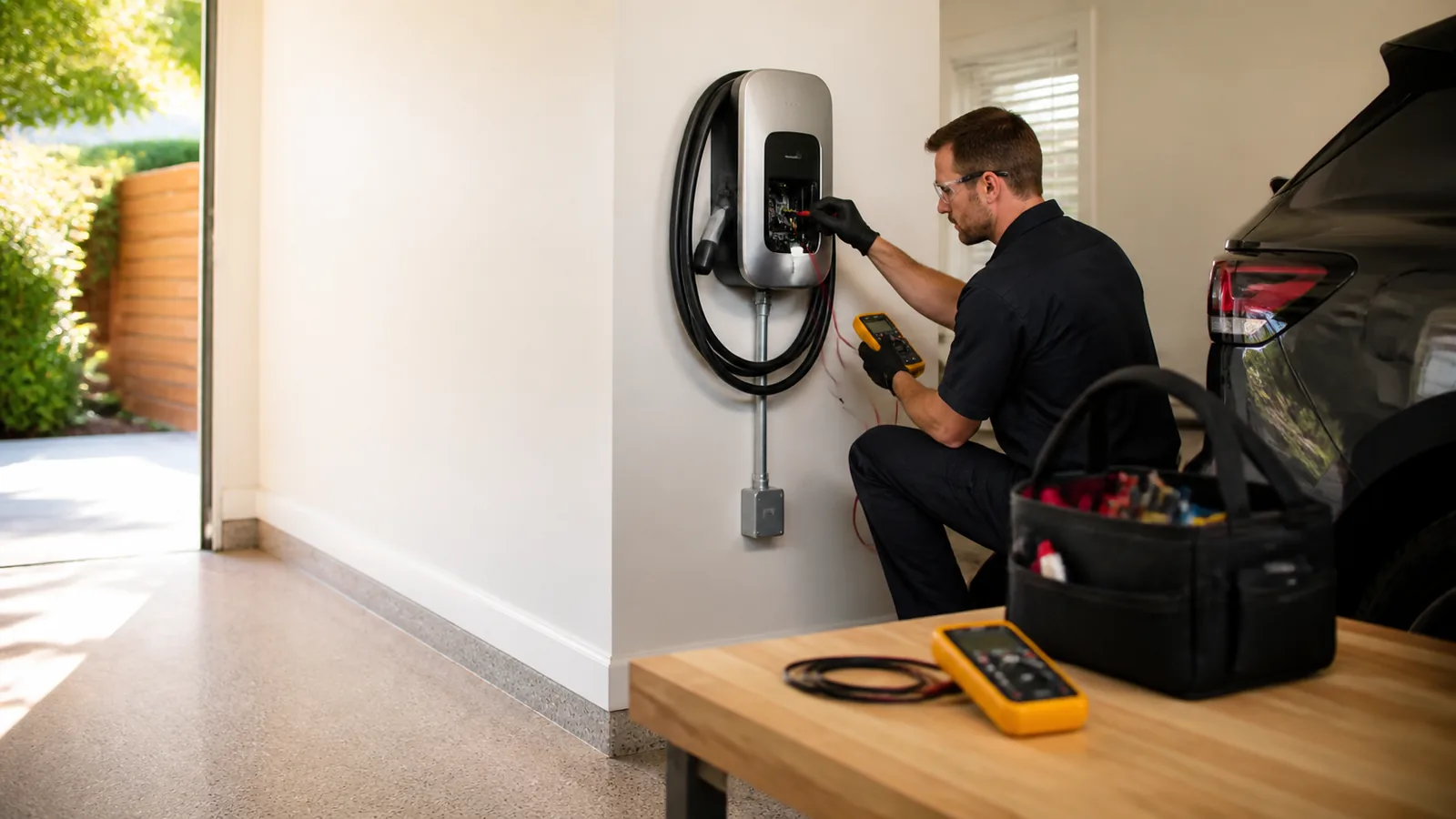
EV Charger Repair guide
EV Charger Repair
EV charger repair should separate the charging equipment from the branch circuit, vehicle, connector, settings, and network services. Similar symptoms can have very different causes, so diagnosis should come before replacement.
Updated July 26, 2026
EV Charger Repair, explained
The key decision is: Is charging failure caused by the vehicle, charger, circuit, connection, settings, or available capacity? A useful repair scope identifies the fault before parts or larger upgrades are recommended.
Start with the affected equipment or area, the visible condition or desired result, and any recent change. The sections below explain the scope choices and quote details that matter for ev charger repair.
When ev charger repair fits
Start with what is not working, when it happens, and whether the condition affects one device, one circuit, or a larger part of the property.
Needs and situations this service covers
- My EV charger isn't working
- Charger is not powering on.
- Charging is slower than usual.
- Breaker trips when charging.
- Fault lights appear on the charger.
What can change the scope
- Faulty or damaged connectors.
- Issues with the electrical circuit.
- Internal charger faults.
- Software or firmware errors.
- The breaker, protection, conductors, disconnect, receptacle or hardwired connection, supplied voltage, and terminations may need testing.
- Testing can review the actual charging load, configured current, equipment leakage or fault, circuit condition, protection devices, and environmental factors.
Is charging failure caused by the vehicle, charger, circuit, connection, settings, or available capacity?
The repair should identify whether the fault is in the charger, circuit, connection, controls, network, or vehicle interface and state what is repaired, replaced, configured, or referred elsewhere.
Power and circuit faults
The breaker, protection, conductors, disconnect, receptacle or hardwired connection, supplied voltage, and terminations may need testing.
Repeated breaker or protection trips
Testing can review the actual charging load, configured current, equipment leakage or fault, circuit condition, protection devices, and environmental factors.
Charger and connector faults
The enclosure, cable, connector, contact condition, control board, indicator, error history, and manufacturer diagnostic path may be involved.
Receptacle and plug problems
A loose, heat-damaged, contaminated, or incompatible receptacle connection may require circuit and equipment evaluation rather than another charging attempt.
Settings, network, and load management
Schedules, current limits, apps, network services, software, energy controls, and shared-charging rules may affect charging without an electrical component failure.
Equipment replacement or upgrade
When repair is unavailable or impractical, the proposal should compare compatible replacement equipment, circuit reuse, mounting, setup, and warranty options.
Useful observations and electrical safety boundaries
Share what you can observe without opening equipment or touching wiring. Energized testing, disassembly, and repair belong to a qualified electrician.
Useful details to note
- Charger and vehicle models, displayed error code, app message, and the date the problem began
- Whether the charger has power, when charging stops, and whether the problem occurs every session or only under certain conditions
- Whether the vehicle charges normally at another compatible location or another compatible vehicle uses this charger normally
- Visible cable, connector, plug, receptacle, enclosure, mounting, water, or impact damage without touching damaged equipment
- Observe charger indicator lights for any fault signals.
- Check for error messages on the charger app.
Leave these steps to an electrician
- Do not repeatedly reset a breaker or protection device that trips during charging
- Do not open the charger, panel, disconnect, receptacle, plug, or connector to inspect internal parts
- Do not raise charger current settings or use adapters to work around slow charging or trips
- Do not continue charging with heat, arcing, burning odor, damaged cables, water entry, or loose connections
- Do not attempt to open or repair the charger yourself.
- Ensure the area around the charger is dry and clear.
Warning signs to mention when requesting help
There is active fire, visible smoke, or a serious electrical injury; The charger does not turn on despite being connected.; The breaker trips repeatedly during charging.; Visible damage to the charger or connectors.; Unresolved error codes or fault lights appear..
How an electrician diagnoses ev charger repair
The exact sequence depends on the symptom, equipment, access, and what testing or planning reveals at the property.
- 1
Review the symptom history
Record charger and vehicle models, error codes, timing, recent changes, weather or water exposure, settings, and previous charging behavior.
- 2
Inspect the charging equipment
Check the enclosure, cable, connector, mounting, plug or hardwired connection, receptacle, indicators, and visible signs of heat or damage.
- 3
Test the electrical supply
Evaluate the branch circuit, protection, conductors, terminations, disconnect, connection point, supplied voltage, grounding, and charging load as appropriate.
- 4
Separate charger, vehicle, and control causes
Use the manufacturer diagnostic path, known compatibility, settings, schedules, network services, load management, and available comparison tests.
- 5
Explain the repair or replacement path
Identify the confirmed fault, repairable components, manufacturer or warranty involvement, replacement options, and any circuit changes required.
- 6
Repair and verify charging
Complete the agreed work, restore settings and connections, and verify a stable charging session while checking the relevant circuit and charger behavior.
- 7
Initial Problem Identification
Identify visible or app-reported issues with the charger.
Get EV charger repair help
Call or request availability to connect with electrician help.
What affects ev charger repair cost
The cost of repairing an EV charger can vary based on the issue and required parts. Treat published ranges as planning references rather than a quote for a particular property.
Type of problem (electrical or mechanical).
Parts required for repair.
Labor time for diagnosis and repair.
Warranty coverage.
| Scope | Typical range | What it usually involves |
|---|---|---|
| Minor Repair | $150-$400 | Simple fixes or adjustments. |
| Moderate Repair | $375-$925 | Involves some parts replacement. |
| Major Repair | $800-$2,275 | Complex issues requiring significant repairs. |
Cost ranges are estimates developed from standardized project scopes and reviewed pricing inputs. Government labor and regional cost data are used where applicable. See our Pricing Methodology for the exact sources, calculations, and review date. Actual prices vary by property, scope, materials or equipment, location, and provider.
How to compare the written scope and quote
Compare what each proposal includes, what assumptions it makes, and how findings that change the scope will be handled, not only the total price.
- Which charger, circuit, connection, vehicle-interface, setting, and network checks are included?
- What fault has been confirmed, and what evidence supports the proposed repair?
- Which parts, cables, connectors, receptacles, breakers, wiring, or replacement charger are included?
- Will manufacturer support, warranty, software, account, or app work be handled, and by whom?
- Are mounting, weather sealing, routing, access, cleanup, and finish repairs included?
- Would any permit, inspection, equipment registration, or utility coordination apply to the repair?
- How will the circuit, charger, settings, connector, and an actual charging session be verified?
- What equipment availability, compatibility, site condition, or additional fault could change the scope?
Common issues related to ev charger repair
Choose the closest visible symptom for a focused explanation of urgency, useful observations, and the service that may fit.


EV Charger Repair: common questions
What should I do if my EV charger is not powering on?
Check the circuit breaker and ensure the charger is securely plugged in. If the issue persists, contact a professional through ElectricianQuotes.
Why is my EV charger charging slowly?
Slow charging can be due to a variety of factors including electrical issues or charger settings. A professional electrician can diagnose and resolve the issue.
What do fault lights on my charger mean?
Fault lights indicate an error or malfunction. Refer to the charger’s manual for specific meanings, or have a professional assess the issue.
Can I repair my EV charger myself?
Repairing an EV charger involves complex electrical work and should only be done by a qualified electrician to ensure safety and compliance.
Sources and editorial review
Service guidance is checked against the government, safety, and consumer sources below. Equipment instructions, site conditions, and the requirements that apply to a specific address can still change the right scope.


Helpful resources
Plan EV charger repair with clearer information
Use these related guides to understand the scope, prepare useful questions, and compare electrical proposals.
Nationwide coverage
EV Charger Repair by state and city
Select a state or popular city to view EV charger repair guidance and check electrician availability in that area.
Get EV charger repair help
Call or request availability to connect with electrician help.
Call (833) 962-0486 to talk through the electrical problem and check electrician availability.